
Topics
- Each topic has short videos, the words to learn and IELTS questions to practise.
- Watch the videos, then learn the words and test yourself.
- Plan answers to the Speaking and Writing questions. Every topic is open in the Library, and the search finds any word or question.
- Everything you save stays in this browser: no account, and nothing is marked or scored.
- Your plans stay on each topic, so you can come back and add to them.
- Clearing your browser data clears your notes too.
- Learn the words before the practice exercises: right answers fill the three dots next to each word.
- Try one Speaking question out loud after you plan it.
- The video pauses when you leave the page.



Open-plan offices
Listen for these words
- open plan
- noise
- teamwork
- concentration
- privacy
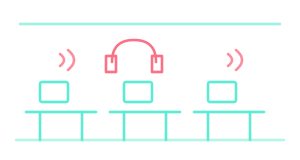
Videos
Vocabulary
open-plan officeadjective + noun · band 6
a large working area with no walls between the desks
“Designers say that open-plan offices make it easier to see what other teams are doing.”
Also: open plan (adjective)
noisenoun · band 6
unwanted loud or unpleasant sound
“Several employees complained that the noise level near the printer made phone calls hard to hear.”
Also: noisy (adjective)
teamworknoun · band 6
the way a group combines its efforts to reach a common goal
“Good teamwork means every member does their share, so the project is finished on time.”
concentrationnoun · band 7
the ability to give all your attention to one thing
“Writing a report requires deep concentration, which is hard to keep when people keep passing your desk.”
Also: concentrate (verb)
privacynoun · band 6
the freedom to be alone or to talk without others watching or listening
“With no walls, there is little privacy for personal calls, so many staff step outside to speak to their doctor or bank.”
Also: private (adjective), privately (adverb)
distractionnoun · band 6
something that takes your attention away from what you are doing
“Phone alerts and passing visitors are constant distractions that make it hard to finish even a simple task.”
Also: distract (verb), distracting (adjective)
collaborateverb · band 7
to join with others to create something or solve a problem
“When staff from different teams sit side by side, they can collaborate with each other on joint projects and swap ideas without booking a meeting.”
Also: collaboration (noun), collaborative (adjective)
Similar: cooperate
face-to-face communicationadjective + noun · band 7
talking with someone in person rather than by message
“Many managers argue that face-to-face communication, where you can see the other person's reaction, is quicker and clearer than a long chain of emails, which can be misread.”
cost-effectiveadjective · band 7
giving good results for the money spent
“Putting more desks in one room is cost-effective, because the firm pays for less floor space.”
Similar: economical
fosterverb · band 7
to help a feeling, skill or relationship grow and develop
“Shared spaces can foster friendships between staff from different departments.”
Similar: encourage
hot-deskingnoun · band 7
a system in which staff have no fixed seat and use any free table
“With hot-desking, the first person in each morning can grab the desk by the window, and everyone must clear their things away at night.”
boost productivityverb + noun · band 7
help people to produce more work in the same amount of time
“Firms hope that better layouts will boost productivity, so that projects are finished faster without longer hours.”
quiet zoneadjective + noun · band 6
an area set aside where talking and phone calls are not allowed
“Some firms mark out quiet zones in a corner of the open floor, where everyone works in library-like silence.”
self-consciousadjective · band 7
worried about what other people think of you
“In a room where everyone can see your screen, some people feel self-conscious about making mistakes.”
Also: self-consciousness (noun), self-consciously (adverb)
overhearverb · band 7
to hear what other people are saying without meaning to
“In a crowded room it is hard not to overhear a colleague's phone call.”
personaliseverb · band 7
to make something suit one individual by adding your own touches
“Employees who cannot personalise their desks with photos and plants often feel less attached to the workplace.”
Also: personal (adjective), personalisation (noun), personally (adverb)
private officeadjective + noun · band 6
a small room for one person, with a door that closes
“In many firms, only the most senior managers still have private offices with doors of their own, away from the open floor.”
partitionnoun · band 7
a thin wall or screen that divides one area of a room from another
“A low partition between desks gives a little privacy without blocking the light.”
stay focusedverb + adjective · band 6
keep your mind on your work without letting it wander
“I wear headphones to help me stay focused when a colleague is talking loudly nearby.”
Speaking Part 1
- When did you last work or study in a room full of other people?
- Do you prefer working in a quiet room or a busy open-plan office?
- Where do you usually do your homework or revision at home?
- How often do you get distracted by noise around you?
- Would you like to share a desk with classmates in the future?
Speaking Part 2
You should say:
- where this place was
- who else was around you
- what you needed to finish
and explain how you managed to keep your attention on the task
Speaking Part 3
- What would happen to teamwork if every employee had a private room?
- How could a company cut down the noise that staff complain about on shared floors?
- Do employers misjudge how much quiet their staff actually need?
- For creative tasks, are shared spaces better than separate rooms?
- What has led so many firms to knock down the walls between desks?
- Is it fair when quiet offices are given only to senior staff?
- Who should be responsible for protecting a worker's need for quiet — the employer or the individual?
- Would you prefer to work in a quiet room or a busy shared space?
- How does noise affect your study?
Writing Task 2
- Many companies have removed walls between desks to encourage teamwork. What are the advantages and disadvantages of this?
- Opinion: Many employers now seat their staff along long shared benches instead of giving each person a separate room. This arrangement does more harm than good to the quality of work. To what extent do you agree or disagree?
- Discuss both views: Some people believe that removing partitions between desks builds a stronger team spirit, while others argue that staff do their best work when they can shut a door. Discuss both these views.
- Advantages and disadvantages: A growing number of employers now house their staff in shared open workspaces rather than separate offices. For the people who work in them, what are the advantages and disadvantages?
- Problem and solution: Many companies now place employees in large shared rooms without dividing walls. What issues can this arrangement cause for staff, and what solutions might help? Who should be responsible for putting them in place?
- Two-part question: More firms now let workers move to a quiet booth whenever they need to focus. Why do many people still choose to sit on a crowded floor, and is this growth in flexible seating a welcome change or a worrying one?