
Topics
- Each topic has short videos, the words to learn and IELTS questions to practise.
- Watch the videos, then learn the words and test yourself.
- Plan answers to the Speaking and Writing questions. Every topic is open in the Library, and the search finds any word or question.
- Everything you save stays in this browser: no account, and nothing is marked or scored.
- Your plans stay on each topic, so you can come back and add to them.
- Clearing your browser data clears your notes too.
- Learn the words before the practice exercises: right answers fill the three dots next to each word.
- Try one Speaking question out loud after you plan it.
- The video pauses when you leave the page.



Vertical farming
Listen for these words
- vertical farm
- indoor
- LED
- yield
- urban
Videos
Vocabulary
vertical farmadjective + noun · band 7
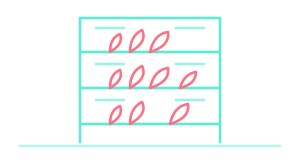
a building where plants are grown on shelves stacked one above another
“The company turned an empty warehouse into a vertical farm, with trays of lettuce stacked on tall racks reaching almost to the ceiling.”
indoor farmingadjective + noun · band 7
the production of vegetables and herbs inside buildings rather than in open fields
“Unlike outdoor growing, indoor farming means that fresh herbs can be picked in the middle of winter, since the plants never have to face frost or snow.”
LED lightingnoun + noun · band 7
low-power electric lamps that can be tuned to suit the needs of growing plants
“Growers fit LED lighting above every tray, so the plants get exactly the colours they need even though no sunshine reaches them.”
crop yieldnoun + noun · band 7
the amount of produce gathered from a given area of growing space
“Because every condition is controlled, the crop yield for each square metre is often far higher than in an open field.”
Also: yield (verb)
urban agricultureadjective + noun · band 7
the practice of growing plants for eating in towns and cities
“Supporters of urban agriculture argue that rooftop gardens and balcony plots could provide neighbourhoods with vegetables picked a few streets away.”
cultivateverb · band 7
to look after plants so that they grow well, usually to be sold or eaten
“Farmers in dry regions find it hard to cultivate delicate vegetables, whereas indoor growers can set the temperature and watering exactly.”
Also: cultivation (noun), cultivated (adjective)
Similar: grow
efficientadjective · band 6
making good use of water, power or materials, with very little lost
“Vertical farms are often described as efficient with water, because the plants sit in a closed system that reuses most of it.”
Also: efficiency (noun), efficiently (adverb), inefficient (adjective)
controlled environmentadjective + noun · band 7
a space where temperature, humidity and watering are set and checked by people
“Lettuce grown in highly controlled environments is protected from storms, frost and drought, so growers can plan harvests with great accuracy.”
pesticidenoun · band 7
a chemical sprayed on plants to destroy small creatures that damage them
“Because pests find it hard to get inside, many vertical farms use little or no pesticide on their crops.”
hydroponicadjective · band 8
describing a method that feeds plants through mineral-rich liquid instead of earth
“Lettuce raised in hydroponic systems can be ready within a few weeks, because the roots sit directly in water and never have to search through soil for food.”
Also: hydroponics (noun)
densely populatedadverb + adjective · band 7
with a very large number of people living in a small area
“In densely populated cities there is little spare land for farming, so growing upwards instead of outwards makes sense.”
start-up costsnoun + noun · band 7
the money a new business must spend before it can begin trading
“The main drawback of tall indoor farms is that start-up costs are very high, as the buildings must be fitted with specialised equipment, lighting and climate control.”
energy-intensivenoun + adjective · band 8
needing a great deal of electricity or fuel to operate
“Critics say vertical farms are very energy-intensive, since lamps, pumps and cooling systems have to run for long hours every day.”
free up farmlandverb + noun · band 7
to stop using land for growing food so that it can be used in other ways, such as for nature or housing
“If more vegetables were grown in towers, we could free up farmland and allow some of it to return to forest.”
make the most of limited spaceverb phrase · band 7
to use a small area as well as possible
“Rooftop growers make the most of limited space by stacking pots and trays in several layers, because they only have a few square metres to work with.”
transport emissionsnoun + noun · band 7
gases released by lorries, ships and planes that carry goods
“Growing salad inside the city reduces transport emissions, because less diesel is burned bringing it in from distant farms.”
premium pricesadjective + noun · band 7
amounts well above normal that buyers pay for goods seen as special or high quality
“Salad grown in towers often sells at premium prices, which many shoppers are unwilling to pay every week.”
unpredictable weatheradjective + noun · band 7
conditions outside that change suddenly and are hard to forecast
“Farmers who depend on unpredictable weather sometimes lose a whole season's income when a late frost or a flood arrives.”
livelihoodnoun · band 7
the means by which a person earns enough money to survive
“Many rural families fear that a switch to tower farming would leave them without work and destroy their livelihoods.”
Speaking Part 1
- Is growing vegetables indoors a common sight where you live?
- Has the variety of fresh food in shops changed since your childhood?
- How important is local production of salad leaves to you?
- Do you think you will visit a city tower farm in future?
- What kind of food from indoor farms would you like to try?
Speaking Part 2
You should say:
- where this place is
- what is produced there
- why the method is different
and explain what you think of this way of growing food.
Speaking Part 3
- What would happen if cities produced a large share of their vegetables inside buildings?
- How could the high electricity use of indoor farms be reduced without raising prices sharply?
- Do people misjudge how much land and water indoor farming really saves?
- Is growing food in towers better than using glasshouses on the edge of towns?
- What has caused investors to put money into urban farming projects recently?
- How fairly are the profits from city farms shared with local workers and residents?
- Who should be responsible for making sure indoor-grown food is affordable for poorer families?
- Would you buy vegetables grown inside a building in the city?
- Could farming be done in a small space like a roof?
Writing Task 2
- Growing food in tall indoor farms could replace traditional agriculture. What are the advantages and disadvantages?
- Opinion: It is sometimes suggested that more food could be grown in stacked indoor layers under controlled lighting rather than in open fields. Would you see this shift in agricultural production as a positive or negative development?
- Discuss both views: Some planners want unused office blocks turned into indoor crop farms; others say these sites should become homes. Discuss both sides and say which you favour.
- Advantages and disadvantages: In some places, shops now sell herbs and salad leaves grown in indoor vertical farms. What are the advantages and disadvantages of this development? In your opinion, is it a positive or negative change?
- Problem and solution: Growing crops in stacked indoor systems may require substantial electricity and offer few local jobs. What difficulties can this situation create, and how might they be addressed? Who should be responsible for putting these solutions into practice?
- Two-part question: It is sometimes argued that shoppers in certain cities now choose more fruit and vegetables produced on vertical farms. Why might consumers make this choice? On balance, do you see this development as a positive or a negative one?